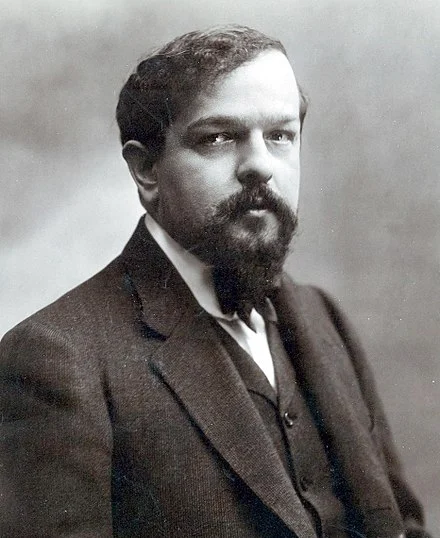
Born in Saint-Germain-en-Laye, France in 1862, Claude Debussy was the creator and leading exponent of French musical impressionism. At age ten, he entered the Paris Conservatory, where he studied piano with Antoine Francois Marmontel and composition with Ernest Guiraod. Over the next ten years, he continued his studies at the Conservatory and became acquainted with a wide range of music as he traveled to Italy, Austria, and Russia.
In 1894, his cantata, The Prodigal Son, won the coveted Grand Prix de Rome. From 1887 on, Debussy confined his activity to composition, rarely appearing in public as a performer. He enjoyed the company of the leading impressionist poets and painters who gathered at the home of the poet Stephane Mallarme. Their influence is felt in Debussy’s first important orchestral work, Prelude to the Afternoon of a Faun (1894). This work established the style of impressionist music and initiated Debussy’s most productive period, which lasted nearly 20 years.
During that time, he composed his one completed opera, Pelleas and Melisande (1892-1902); the orchestral suites Nocturnes (1893-99), The Sea (1903), and Images (1906-09); most of his piano music, including the books of Preludes(1910-13); the ballet, Games (1912); and one of his best known piano compositions, Claire de Lune, from Suite Bergamasque (1890-1905).
Around 1910, Debussy developed cancer, which sapped his strength during his last years. Many projects were started, such as an opera based on Edgar Allan Poe’s The Fall of the House of Usher, but few were completed. He died in Paris in 1918.