
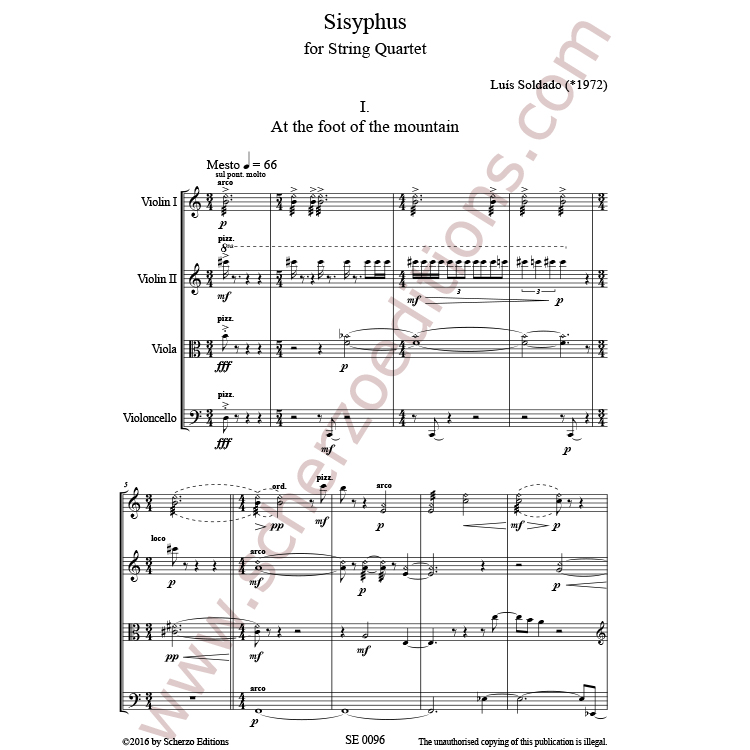
Sisyphus was inspired by the philosophical essay, by Albert Camus, The myth of Sisyphus (1942). The mythical figure Sisyphus, (who because of his passion for life, his hatred for death and his scorn for the gods) is condemned by the gods to roll a stone endlessly up to the top of a hill, only to have it roll back down and start his task all over again. The titles of each of the five movements of Sisyphus were taken from the actual essay itself.
Each movement is completely different from the one before in style, colour and character. Sometimes the transition between movements is quite smooth, like between movements II and III, other times is more abrupt like for example between movements IV and V . The intention however is basically the same – to raise the listener’s level of expectation. As I said earlier, controlling the level of the listener’s expectation should be a central point in the craft of any composer. Thus by presenting the listener with very distinct movements, their level of expectation should rise because they soon realize that they really do not know what to expect next but they are aware that something is supposed to be expected.
The form of the piece is again, as in some of my previous works, related with the Dramatic Arc. The five movements are to be played without interruption between them though there is a solid bar at the end of each movement. Each movement describes a particular step of Camus’ description and analyses of the Sisyphus myth, thus a Dramatic Arc form seemed appropriate. Luís Soldado


Reviews
There are no reviews yet.